

Every ambitious founder today makes a familiar claim: “We’re building with AI.”
A few years ago, that statement implied differentiation. Today, it barely signals intent. As artificial intelligence becomes cheaper, faster, and widely accessible, the real challenge has shifted upstream. The defining question of this era is no longer how to build with AI, but what to build with it. In other words, the hardest problem is not execution; it is idea selection.
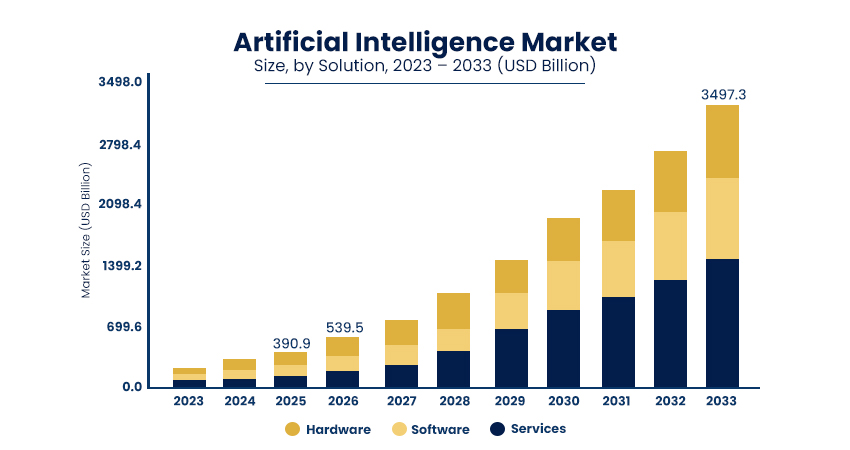
This shift matters because AI is rapidly becoming infrastructure rather than innovation. The global AI market, valued at roughly USD 390 billion in 2025, is projected to grow beyond USD 3.4 trillion by 2033, with compound annual growth exceeding 30%. PwC also estimates AI could add up to USD 15.7 trillion to global GDP by 2030, making it arguably the largest commercial opportunity of the modern economy.
Yet scale alone does not translate to value creation. Despite growing investment and integration, only a fraction of companies are seeing meaningful returns from AI strategies. According to recent research, only about 26% of companies have developed the capabilities to move beyond pilots and generate tangible value, with the remaining 74% still struggling to scale AI in ways that materially impact revenue or cost.
This means that while billions are being poured into AI, the constraint is no longer access to models; it is clarity of idea.
In the AI era, the idea is no longer the technology itself. Models are becoming commoditised, capabilities diffuse quickly, and technical advantages decay fast. What endures is not using AI, but deciding where intelligence should live permanently within a product or workflow.
A strong AI idea begins by identifying recurring themes for decision-making, one that is expensive, inconsistent, or difficult to scale, and embedding it irreversibly into software. When AI sits at the surface as a feature or add-on, it can be copied or replaced. In contrast, when intelligence is the cornerstone of how value is delivered, removing AI breaks the product.
VCs are already pricing this distinction. AI startups accounted for over half of global venture capital funding in 2025, with some estimates showing AI commanding 53% of global VC investment and record billions in capital deployment. This marks a historic shift in startup finance and innovation prioritisation, one where AI isn’t just a trend but a core thesis for backable businesses.
Encoding Judgment, Not Automating Tasks
This distinction explains why many AI products feel impressive yet fragile. Assistance tools improve productivity but still rely on humans to interpret, decide, and act. Substitution systems, by contrast, absorb decision-making responsibility within defined constraints and operate continuously rather than episodically.
In enterprise AI, for example, chatbots that answer FAQs reduce support load but still escalate judgment calls to humans. In contrast, systems that autonomously resolve refunds, prioritise complaints based on lifetime value, and adapt responses dynamically are encoding judgment rather than merely automating tasks.
A 2025 survey of CEOs showed that although 68% of large organisations plan to increase AI spending in 2026, less than half have seen positive returns from their AI investments so far, with success concentrated in areas like marketing and customer service rather than core decision-making workflows.
AI systems that replace judgment convert scarce, high-cost human expertise into always-on decision engines, fundamentally reshaping cost structures and margins, but only when intelligence is embedded deeply into the workflow itself.
Compression of Expertise as the Real Unlock
This compression of expertise turns costly human judgment into automated infrastructure. It is already visible across categories. In health and wellness, hyper-personalised platforms ingest real-time activity, sleep, and recovery data to replicate the roles of nutritionists and trainers without human intervention. What once required around $500 per month in professional services can now be delivered as a continuously learning system that scales arbitrarily.
A similar transformation is underway in education technology, where AI-driven tutoring platforms adapt pacing, content difficulty, and reinforcement in real time based on learner behaviour — replicating the judgment of experienced instructors at scale rather than providing static recommendations.
These systems don’t succeed because they predict outcomes; they succeed because they translate signals into decisions that users previously outsourced to experts, a structural quality that creates stickiness and defensibility.
Why Vertical Depth Creates Defensibility
Vertical depth is what makes these ideas defensible. Horizontal AI platforms optimise for breadth, but domain-specific judgment, the real value, lives in context, constraints, and actionable outputs.
VC funding trends reinforce this. In Q1 2025, AI funding grew to USD 66.6 billion across 1,134 deals, including many vertical applications and infrastructure plays, setting a new quarterly record.
Vertical AI companies often capture substantial valuation premiums as they embed themselves into workflows that are hard to displace. According to PwC’s Global Top 100 Unicorns report, AI-focused companies now account for about 43% of total unicorn valuation, and their collective valuation jumped 122% year-over-year, reflecting investor confidence in the strategic advantages of embedded intelligence.
In logistics, for example, routing algorithms that merely optimise distance are easily replicated. Systems that account for local regulations, vendor reliability, weather disruptions, and historical delay patterns create far deeper moats precisely because they encode domain-specific judgment into decision workflows.
Integration Depth Over Model Size
A clear illustration of an architectural moat is found in financial wellness products tailored to local contexts. Platforms that analyse transaction histories with user consent and provide prescriptive cash-flow and investment guidance aligned with local tax regimes and market volatility outperform models that offer generic financial advice. These systems win not because they use larger models, but because they understand and operationalise domain nuance and behavioural patterns that cannot be easily replicated.
In essence, the intelligence in these products is inseparable from context, a key criterion venture capitalists look for when evaluating long-term defensibility.
From Prediction to Prescription
The most meaningful inflection occurs when AI systems move from prediction to prescription. Predictive systems still leave decisions to humans, creating latency and inconsistency. Prescriptive systems close the loop by recommending actions within real-world constraints.
Luxury groups like LVMH have demonstrated this shift through digital twins of their supply chains that simulate scenarios and actively guide inventory allocation using purchasing patterns and social sentiment. These systems do not merely forecast demand; they execute decisions that protect scarcity value and minimise lost sales. In that sense, where predictive systems inform, prescriptive systems decide, and that difference drives outsized returns and strategic advantage.
Trust as a System Constraint
As AI ideas move closer to decision-making, trust becomes a system constraint rather than a communications problem. Rising concerns about data privacy, transparency, and misuse of AI services underscore that long-term adoption requires systems that users can understand, control, and trust. Research shows that customer retention increases between 25% and 95% when personalisation feels responsible and accountable. Yet, such outcomes are sustainable only when trust is engineered into how decisions are made, not merely how they are marketed.
The strongest AI systems are designed for explainability, consent, and reversibility from the outset. When users understand why a decision was made and feel they retain agency, trust compounds alongside performance. When trust is an afterthought, even technically superior systems struggle to scale beyond early adopters.
Choosing the Right Idea
Ultimately, picking the right idea in the AI era is about deciding where intelligence belongs in the stack and how permanently it can be embedded into real-world workflows. As AI models and tools become interchangeable, architecture, not algorithms, becomes the true differentiator.
The companies that endure will not be those that adopt AI first, but those that encode judgment into systems, replace decisions rather than tasks, and design infrastructure rather than features. The real winners of this era will not look like AI companies.
They will look like businesses whose core systems happen to think.